
Biennial sowing guide
As we move into summer my cutting garden is really getting into its stride, the sweet peas are racing up their climbing frames, the autumn sown annuals are just starting to flower and the spring sown annuals are settling in and getting ready to flower their socks off. But there is another group of flowers in my garden that have been flowering since April and will go on until end of June and that is the biennials. They are my favourites as this time of year, it started in April with Honesty and Wallflowers, in May we had Sweet Rocket and just starting now in June we have Sweet William and Foxgloves and still to come just about to burst into flower any day now are the Canterbury Bells.
So what is a biennial, they are plants with a life cycle spanning two years, you sow them now they will germinate and grow into a small plant which you plant in the late-summer/autumn, so they can set a good root system and get well established before the winter comes. In winter they go dormant and sit out the cold weather, then come spring they burst into growth and flower in April to June. However they need sowing now, June is the perfect time. Oh I hear you say, not another thing to add to my never-ending garden to-do list! Well yes I know myself that now is such a busy time, there is all the planting of the annuals, Dahlias potting up and putting out, clearing of spring bulbs, tying in the sweet peas, not to mention all the weeding, watering and feeding, plus I do want some time to actually pick the flowers. But let me convince you that they are worth it……
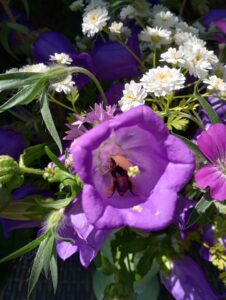
Firstly they fill a gap in the cutting garden, flowering at a time before your autumn and spring sown annuals are ready and after the spring bulbs have finished so really extend your cutting season. Many are scented, Wallflowers, Hesperis and Sweet William all have delicious scents. In fact I’d say the scent of wallflowers is one of my favourite in the garden, a sweet honey scent but not too overpowering. Finally even if you are not especially interested in having them for cutting they are great for pollinators, especially in April when there might not be too many flowers in your garden. Foxgloves and Canterbury bells are just loved by bumblebees, they love climbing into those bell shaped blooms. Surely I’m starting to convince you now, but lets talk about sowing and growing.
And so to sowing, they are very easy and all very reliable for germination. Nore information can be found in the Higgledy Garden Seed sowing guide. There are two ways that you can sow them. Firstly you could sow them directly into a bed or border. As with any direct sowing, clear the ground of weeds, dig over the soil, sow the seed by broadcasting over the bed or in rows where you would like them to grow. Sow thinly, cover with a thin layer of soil and and once germinated thin out to the required final spacing. However if you are anything like me there is not a spare bed or bit of soil in my garden in June so I sow into seed trays. Again sow thinly in seed trays or 9cm pots, cover lightly with compost and prick out into individual modules or pots. Then you can plant them later in the season when you remove some of your annuals and into their final places. Plant out in September so they have time to get established before the weather turns. Then they will be fine to sit for the winter. Obviously the weather is warm in June, so they don’t need to be put in a greenhouse, I just place them in a sheltered part of the garden, not in baking sun but in a place where you will see them. You will need to keep them well watered until they germinate and then prick them out and the pots taken care of over the summer.
A couple of specific things, Canterbury bell and Foxglove seeds are tiny and so even more important to sow thinly in a seed tray, they need light to germinate so I cover with a just a sprinkling of vermiculite and always always water from below. I have made the mistake of watering with a watering can and all the seed washes to the corner of the tray making them really tricky to prick out. Prick out and pot on as soon as you can as they grow quickly and like to keep growing smoothly, this seems especially important for wallflowers which can soon go woody.
Just another note, many of them, like Sweet Rocket, Sweet William and Wallflowers will often come back and flower again in the following year, they can be short lived perennials. Wallflowers can go woody after a while so good to start again after the second year. My Sweet William this year are looking great despite being planted in 2024. But I will sow some fresh for next year. All of these biennials are also really easy to collect seed from in your garden for sowing in subsequent years (don’t tell Ben I told you that!). Or just let them self seed, I’m always getting Hesperis and Foxglove seedlings coming up round my garden.
Need any more of a nudge? Lets go through the flowers.
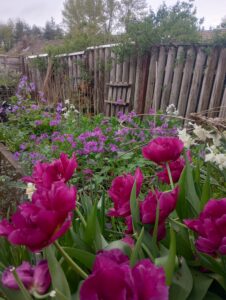
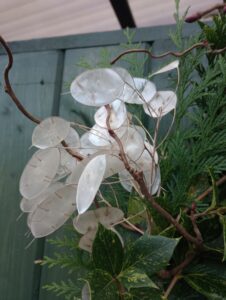
So lets start with Honesty, they are the first to flower in my garden, they come in a range of purple tones and white flowers. They look pretty as filler flowers in arrangements but I tend to leave them to set seed for their beautiful moon-shaped seed heads which look great in arrangements when they are green but also when they have dried and you can peel off the outer seed case and just leave a translucent disc. Great to use in winter arrangements or on wreaths.
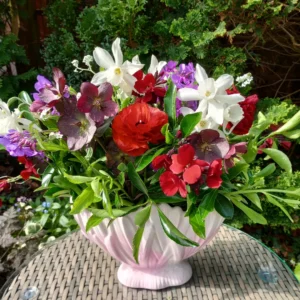
Wallflowers are flowering in April too, we sell a beautiful range of colours, ‘Cloth of Gold’ a beautiful warm yellow the colour of egg yolk, ‘Ivory White’ which isn’t white at all but a pale yellow in bud which fades to cream, ‘Ruby Gem’ a vibrant pink and ‘Vulcan’ a rich dark red. Between them you have a great mix which goes with multiple colour schemes.
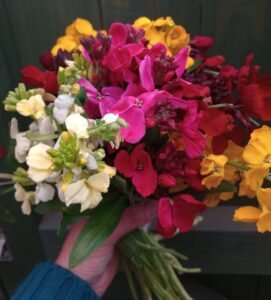
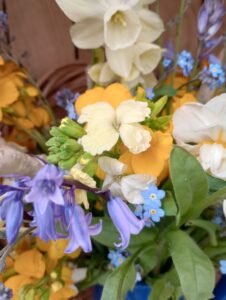
My favourite spring colour combination is yellows and blues so ‘Ivory White’ and ‘Cloth of Gold’ look great together along with Forget-me-nots and Bluebells and Narcissus.

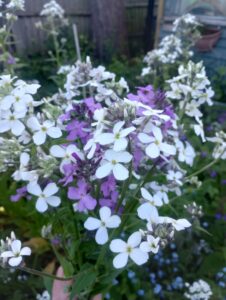
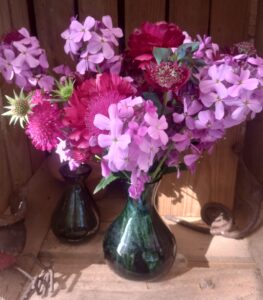
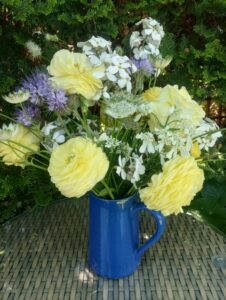
Next we have Hesperis, we sell both Hesperis ‘Purple’ and Hesperis ‘White’, this is one of my favourite biennials as you get to cut so much from one plant, you cut the main stems and then you get lots of smaller side stems for many weeks.This year I had a lovely pale pink form which I must try and collect some seed from.
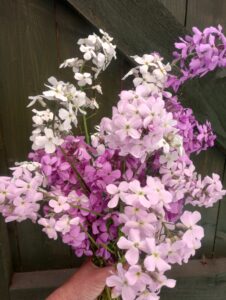
The purple looks great with darker colour schemes, like this one with

The white looks beautiful on many schemes, like this pale yellow, white and blue arrangement.

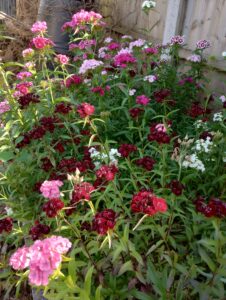
June brings the glorious Sweet Williams which along with their fabulous rich clovey scent and also really long flowering in a vase and so easy to cut and prep. I especially love the rich dark Sweet William ‘Nigricans’ which often starts flowering in my garden at the same time as the autumn sown Cornflower ‘Black Ball’ and I love using them both in more monochrome schemes.
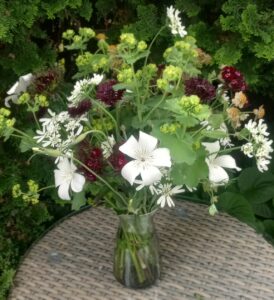

Here is Sweet William ‘Alba’ in a airy simple posy


But a glorious mix of colours is a joy too.
Foxgloves are just a perfect cottage garden plant, I love a big swath of them. Here is Digitalis ‘Excelsior’ and Digitalis ‘Apricot’ in my garden a few years ago and we have Digitalis ‘Alba’, a beautiful white form. I wish I had more space in my garden to grow them like this again.
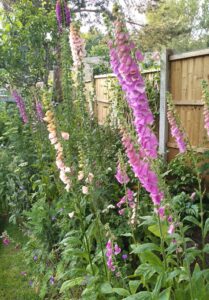
I tend to leave them for the bees rather than cutting them!
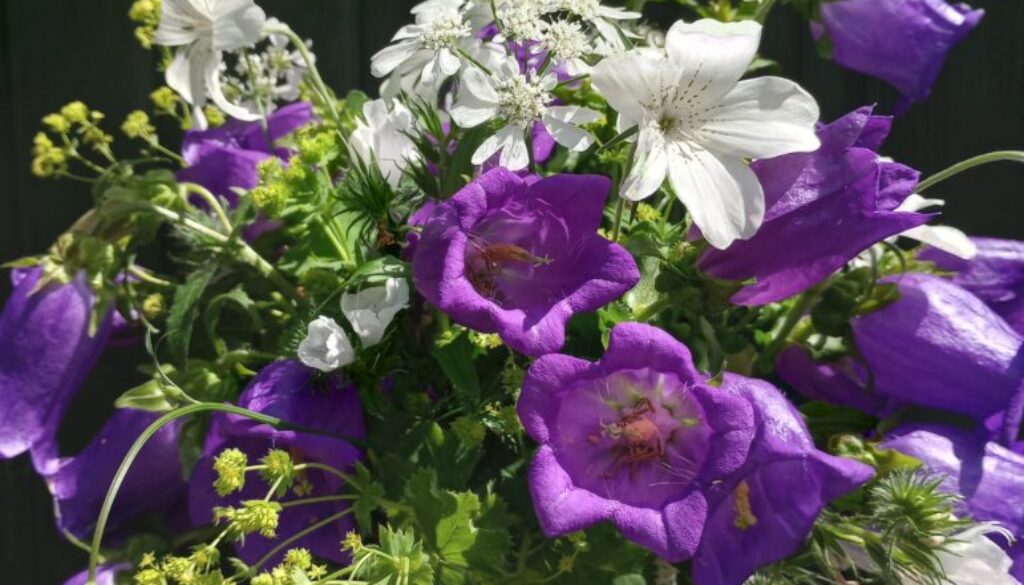
Finally mid-June we have Canterbury Bells, I some how missed out on them last year and I’m currently waiting for them to flower this year but oh what a joy they are. In a range of colours from white, to pink and various shades of purple. I especially loved this pale lavender form, which I have here with Alchemilla mollis, Cornflower ‘Black Ball’ and ‘Mauve Ball’ and Silene vulgaris.
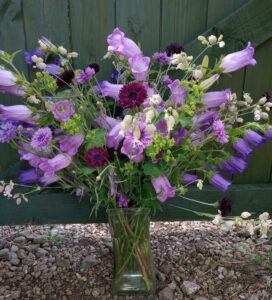
You can pick the long main stems but then, as with the Hesperis, you get lots of shorter side shoots so a good long flowering time. So you can make smaller posies like the one below with Cosmos ‘Apricotta’ and Phlox ‘Creme Brulee’.
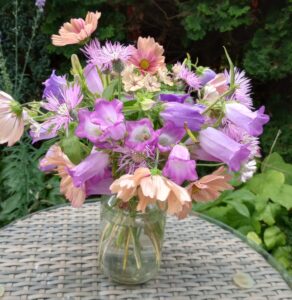
The plants would look great just in your borders as well. I can’t wait to have a play with different combinations this year.
So there you go, a guide to sowing, growing, cutting and arranging biennials, will you give it a go this year?
Happy sowing and growing
Higgledy Anne
(I’m on Instagram anne_hinks if you fancy a follow)